React use cases
Three architectures built on pdfnative-react v1.3.0 (peer
pdfnative ^1.8.0, React^19.0.0, Node ≥ 22). Lint a document model in CI before any PDF exists; typeset long-form documents like a book from JSX; and render one component tree into a screen PDF/A file and a press PDF/X-4 file. Every prop, export and lint rule named below ships in v1.3.0.
This guide is the React companion to the ecosystem use cases,
which sets the convention (problem, load-bearing code, gains, limits — with an
architecture diagram where data crosses components) and covers the cross-surface architectures. The
React guide is the reference for the components, the rendering
entry points and the DocSpec authoring surface used here.
Case 1 — A DocSpec lint gate in CI, before any PDF exists#
Most document bugs are visible in the model long before a byte is written: a
PDF/A claim with no embedded fonts, a chart with two series in a pie, a
pdfx document whose output intent is a monitor profile. pdfnative-react
compiles JSX and DocSpec to the same DocumentParams, and lintDocument /
lintSpec run 37 rules on that model — 23 errors, 13 warnings, 1 info —
without rendering. The twelve rules added in v1.3.0 cover the engine 1.8.0
surface: L_TYPOGRAPHY_INEFFECTIVE, L_PRINT_COLOUR_BARS,
L_CMYK_INTENT_MISMATCH, L_OUTPUT_INTENT_PROFILE and the eight
L_PDFX_* rules (L_PDFX_TARGET, L_PDFX_TAGGED_CONFLICT,
L_PDFX_ENCRYPTED, L_PDFX_OUTPUT_INTENT, L_PDFX_TRAPPED_UNKNOWN,
L_PDFX_BOXES, L_PDFX_NO_FONTS, L_PDFX_ANNOTATIONS).
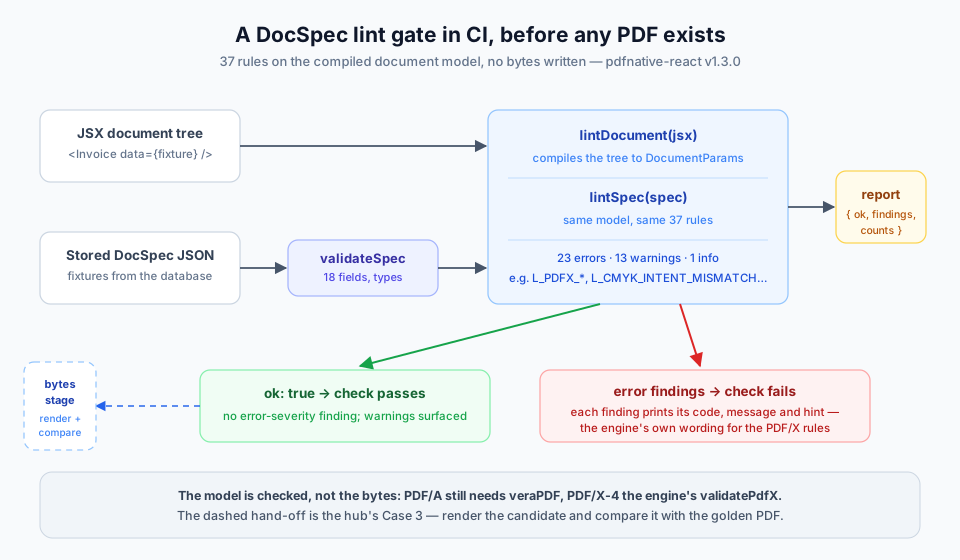
The stored-spec route pairs validateSpec (is this JSON a DocSpec at all —
unknown fields, wrong types, the 18 DOC_SPEC_FIELDS including the 1.3.0
pdfx, outputIntent, typography and creationDate) with lintSpec (is
it a document the engine will accept and a reader can use). Both return plain
data: a LintReport is { ok, findings, counts }, where ok is false only
when a finding has severity 'error'.
// tests/documents.lint.test.tsx — runs on every pull request; writes nothing.
import { describe, expect, it } from 'vitest';
import { lintDocument, lintSpec, validateSpec } from 'pdfnative-react';
import type { DocSpec } from 'pdfnative-react';
import { Invoice } from '../src/documents/Invoice.js';
import stored from './fixtures/stored-specs.json'; // DocSpecs as the database holds them
import fixture from './fixtures/invoice.json';

describe('document lint gate', () => {
  it('the JSX invoice has no blocking finding', () => {
    const report = lintDocument(<Invoice data={fixture} />, { overflow: true });
    expect(report.findings.filter((f) => f.severity === 'error')).toEqual([]);
  });
  it.each(stored)('stored spec $title still validates and lints', (spec: unknown) => {
    expect(validateSpec(spec).errors).toEqual([]);        // shape: fields and types
    const report = lintSpec(spec as DocSpec);             // model: engine + accessibility
    expect(report.ok, JSON.stringify(report.findings, null, 2)).toBe(true);
  });
});
What you gain, concretely:
- Throws become findings. Of the 37 rules, twenty pre-empt an exception the
engine raises at build time and five mirror an engine diagnostic (a warning
on the default channel, a throw under
layout.strict). For the six PDF/X coherence rules the finding's message is the engine's message. - One report for both doors. JSX and JSON compile to the same model, so a
rule written once covers the component tree your developers write and the
specs your agents or your database produce. The rule table is exported as
LINT_RULES, the code list asLINT_RULE_CODES. - Composes with the hub. This is the model stage; hub
Case 3 is the
bytes stage (
render+compareagainst a golden PDF), and hub Case 1 is where the stored specs in the fixture come from.
Honest limits: lint checks the model, not the bytes. A PDF/A claim is
still verified by veraPDF on the rendered file, and a PDF/X-4 claim by the
engine's structural validator, which is deliberately not re-exported — it is
one import away, as docs/RECIPES.md in the package shows:
import { validatePdfX } from 'pdfnative';
import { renderToBytes } from 'pdfnative-react';
const { valid, errors } = validatePdfX(renderToBytes(<PressSheet />));
L_OVERFLOW (a block taller than the page) needs a full layout pass and is
opt-in through { overflow: true } — it costs about as much as rendering.
There is no visual check: nothing in the model says whether the page looks
right.
Case 2 — Long-form documents typeset like a book, in JSX#
A report that runs to forty pages exposes every default of a naive
paginator: a heading stranded at the foot of a page, a single line carried to
the next one, ragged right margins in a two-column brief. Engine 1.8.0 ships a
typography engine, and pdfnative-react v1.3.0 exposes it as a <Document>
prop (typography, sugar over layout.typography) with per-block overrides:
<Heading keepWithNext>, <Paragraph align="justify" keepWithNext splittable>.
import { Document, Heading, Paragraph, Table, inspectDocument, renderToBytes,
         resolveFonts, setHyphenationProvider } from 'pdfnative-react';
const fontEntries = await resolveFonts({ latin: () => import('pdfnative/fonts/noto-sans-data.js') });
setHyphenationProvider((word, lang) => hyphenate(word, lang)); // optional: your Liang-pattern library

const book = (
  <Document title="Field guide" fontEntries={fontEntries}
            typography={{ splitParagraphs: true, orphans: 2, widows: 2,
                          keepHeadingsWithNext: { minLines: 3 }, opticalMargins: true,
                          kerning: true, fontFeatures: ['onum'], hyphenationLanguage: 'en' }}>
    <Heading level={1}>Chapter 1</Heading>
    <Heading level={2} keepWithNext>Habitat</Heading>
    <Paragraph align="justify" splittable>{chapterOne}</Paragraph>
    <Paragraph keepWithNext>Table 1 summarises the ranges:</Paragraph>
    <Table rows={ranges} />
  </Document>
);
const { totalPages } = inspectDocument(book);          // the same planner, no bytes
if (totalPages > 48) throw new Error(`page budget exceeded: ${totalPages} pages`);
const bytes = renderToBytes(book);
inspectDocument runs the planner that renderToBytes uses and returns the
page count and every block's placement, so a page budget or a "table 1 is on
the same page as its caption" assertion is a unit test, not a PDF you open.
What you gain, concretely:
- All twelve engine keys, locked at compile time.
splitParagraphs,orphans,widows,keepHeadingsWithNext,unitBinding,bindShortWords,punctuationSpacing,opticalMargins,metrics,fontFeatures,kerningandhyphenationLanguageare typed against the engine'sTypographyOptions; a key the engine adds later is a build error in pdfnative-react, not a silently ignored prop. - Byte-identical when unset. A document without
typographycompiles to the sameDocumentParamsas before; every key is opt-in. - Ineffective settings are warnings before render.
L_TYPOGRAPHY_INEFFECTIVEreportsorphans/widowswithoutsplitParagraphs, an unknownfontFeaturestag, a line quota below 1, andkerning,fontFeaturesor the'fr'punctuation preset without a registered font.
Honest limits: kerning, fontFeatures and the narrow no-break space of
punctuationSpacing: 'fr' need a registered font (fontEntries) — the
base-14 faces carry no OpenType tables and no U+202F. tnum and lnum are
no-ops on the bundled Noto Sans, whose figures are tabular and lining already.
No hyphenation dictionary ships: soft hyphens (U+00AD) are honoured, and a
provider set through setHyphenationProvider receives hyphenationLanguage
with every word. The React renderer does not sign, fill forms or post-process
existing PDFs — hand its bytes to the CLI or the engine for that.
Case 3 — One component tree, two palettes: screen PDF/A and press PDF/X-4#
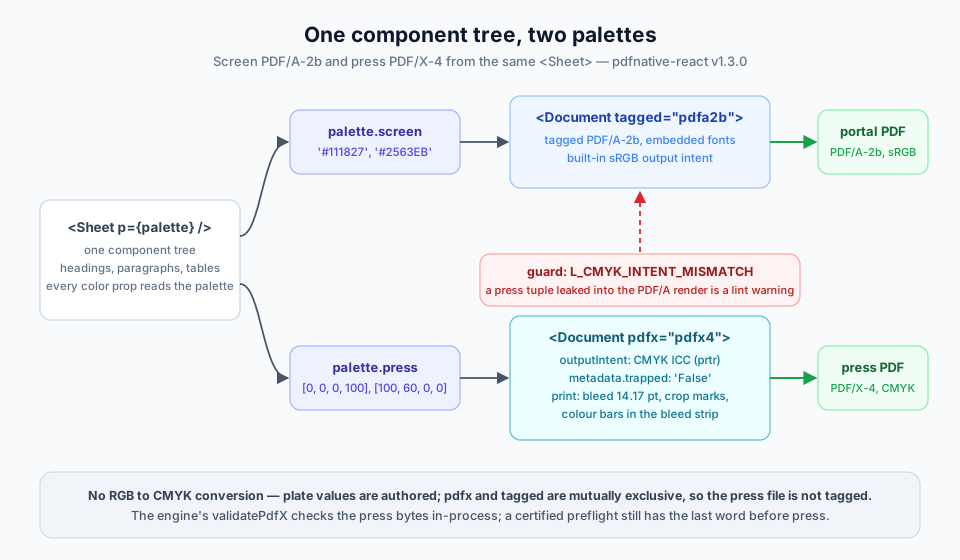
The same catalogue goes to a customer portal and to a printer, and the two
files have contradictory requirements: the portal wants a tagged PDF/A-2b file
with sRGB colours; the press wants PDF/X-4 with CMYK plate values, a printer
output intent, a bleed and colour bars — and PDF/X forbids the tagged
claim. In v1.3.0 every colour prop accepts a CMYK value beside hex and RGB, and
pdfx, outputIntent and print are <Document> props, so the palette is
the only thing that changes between the two renders.
import { Document, Heading, Paragraph, renderToBytes } from 'pdfnative-react';
const palette = {
  screen: { ink: '#111827', accent: '#2563EB' },              // hex, for the portal
  press:  { ink: [0, 0, 0, 100], accent: [100, 60, 0, 0] },   // C M Y K in percent, for the press
} as const;

const Sheet = ({ p }: { p: (typeof palette)[keyof typeof palette] }) => (
  <>
    <Heading color={p.ink}>Spring catalogue</Heading>
    <Paragraph color={p.accent}>Prices valid until 30 June.</Paragraph>
  </>
);

const portal = renderToBytes(
  <Document tagged="pdfa2b" fontEntries={fontEntries}><Sheet p={palette.screen} /></Document>);
const press = renderToBytes(
  <Document pdfx="pdfx4" fontEntries={fontEntries} metadata={{ trapped: 'False' }}
            outputIntent={{ iccProfile: pressProfile, outputConditionIdentifier: 'FOGRA39' }}
            print={{ bleed: 14.17, marks: { crop: true, colourBars: true } }}>
    <Sheet p={palette.press} /></Document>);
iccProfile is the printer's ICC profile as bytes (a prtr device class —
a monitor profile such as sRGB is refused by L_PDFX_OUTPUT_INTENT), and
trapped: 'False' states the trapping status PDF/X requires — pdfnative never
traps. A 5 mm bleed (14.17 pt) is the strip the engine recommends for the
colour bars: below it the patches fall under a densitometer aperture and
L_PRINT_COLOUR_BARS warns; under 4 pt the engine skips the bars.
What you gain, concretely:
- One tree, two conformance claims. The components, the copy and the
layout are written once;
tagged="pdfa2b"andpdfx="pdfx4"are wrapper props, not forks of the template. - A leaked press token is a lint warning. A CMYK value inside the PDF/A
render trips
L_CMYK_INTENT_MISMATCH(the built-in PDF/A intent is sRGB), mirroring the engine'sPDFA_DEVICE_CMYK_CONTENTdiagnostic; a monitor profile on the press render tripsL_PDFX_OUTPUT_INTENT. Skip the linter and the profile error reachestoErrorEnvelopeasE_INPUT, while the CMYK leak stays aPDFA_DEVICE_CMYK_CONTENTdiagnostic (a throw only underlayout.strict). - Press marks without a prepress tool.
print.marks.colourBarsdraws the four process colours at 100 % and 50 % in the bottom bleed strip; the crop marks stop 0.5 pt short of the trim line.
Honest limits: there is no RGB → CMYK conversion — plate values are
authored, and the engine performs no colour management beyond mapping RGB
content under a CMYK or Gray intent through /DefaultRGB. pdfx and tagged
are mutually exclusive (one conformance claim per file), so the press file is
not tagged. The bytes-level PDF/X-4 check is the engine's validatePdfX
import shown in Case 1, and a valid result means the structural
prerequisites hold — confirm the file with a certified preflight before it goes
to press. No press profile ships with either package; the ICC profile is yours.
See also#
- Ecosystem use cases — the hub: stored specs, air-gapped PAdES B-LTA, the CI regression gate, edge caching and zipnative as the DEFLATE codec.
- React guide — components, rendering entry points and the
DocSpecauthoring surface. - CLI use cases and MCP use cases — the sibling per-surface guides.
- React playground — the JSX renderer in the browser.
- DocSpec lint playground — paste a
DocSpec, read the 37-rule report.